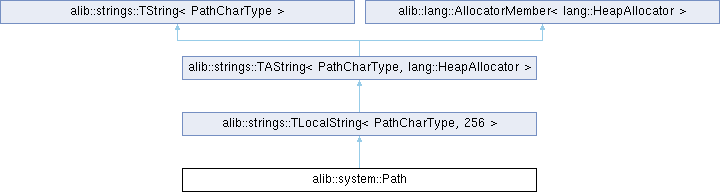
Represents a directory or file in a file system.
Inherits a local string buffer fixed to size 256. The flexible nature of ALib local strings allows dynamic allocation if this should be exceeded (which usually is not expected with paths).
The character type of templated parent class AString is defined by the type definition system::PathCharType, which in turn aliases std::filesystem::path::value_type.
Definition at line 156 of file path.inl.
|
| | Path () |
| | Path (const PathString &path) |
| | Path (SystemFolders special) |
| | Path (SystemFolders special, const PathString &fileName) |
| Path & | Add (const PathString &dirOrFilename) |
| void | AddModuleName (const PathString &extension) |
| bool | Change (const PathString &path) |
| bool | Change (SystemFolders special) |
| void | Change (SystemFolders special, const PathString &fileName) |
| bool | ChangeToParent () |
| std::errc | Create () |
| std::errc | Create (const PathString &path) |
| int | IsAbsolute () const |
| bool | IsDirectory () |
| std::errc | MakeCanonical () |
| PathString | Name () const |
| PathString | Parent () const |
| constexpr | TLocalString (lang::HeapAllocator &pAllocator) |
| TLocalString & | operator= (const TLocalString ©) |
| | ~TAString () noexcept |
| | Destructs an AString object. An internally allocated buffer will be deleted.
|
| TAString & | _ (const TAppendable &src) |
| TAString & | Append (const TCharSrc *src, integer srcLength) |
| const_iterator | begin () const |
| integer | Capacity () const |
| void | dbgCheck () const |
| void | DbgDisableBufferReplacementWarning () |
| TAString & | Delete (integer regionStart, integer regionLength=MAX_LEN) |
| TAString & | DeleteEnd (integer regionLength) |
| TAString & | DeleteStart (integer regionLength) |
| integer | DetectLength (integer offset=0) |
| const_iterator | end () const |
| void | EnsureRemainingCapacity (integer spaceNeeded) |
| void | GrowBufferAtLeastBy (integer minimumGrowth) |
| bool | HasInternalBuffer () const |
| TAString & | InsertAt (const TString< PathCharType > &src, integer pos) |
| TAString & | InsertChars (PathCharType c, integer qty) |
| TAString & | InsertUninitialized (integer pos, integer size) |
| TAString & | NewLine () |
| constexpr | operator T () const |
| TAString & | operator+= (const TAppendable &src) |
| TAString & | operator<< (const TAppendable &src) |
| TAString & | operator= (const TAString ©) |
| PathCharType | operator[] (integer idx) const |
| constexpr PathCharType | pop_back () |
| constexpr void | push_back (PathCharType ch) |
| const_reverse_iterator | rbegin () const |
| const_reverse_iterator | rend () const |
| TAString & | ReplaceRegion (PathCharType c, integer regionStart, integer regionLength) |
| TAString & | ReplaceSubstring (const TString< PathCharType > &src, integer regionStart, integer regionLength) |
| TAString & | Reset () |
| TAString & | Reverse (integer regionStart=0, integer regionLength=MAX_LEN) |
| integer | SearchAndReplace (PathCharType needle, PathCharType replacement, integer startIdx=0, integer endIdx=strings::MAX_LEN) |
| void | SetBuffer (integer newCapacity) |
| void | SetCharAt (integer idx, PathCharType c) |
| void | SetLength (integer newLength) |
| void | SetNull () |
| | Invokes SetBuffer(0).
|
| TAString & | ShortenBy (integer charsToRemove) |
| TAString & | ShortenTo (integer newLength) |
| constexpr const PathCharType * | Terminate () const |
| TAString & | ToLower (integer regionStart=0, integer regionLength=MAX_LEN) |
| TAString & | ToUpper (integer regionStart=0, integer regionLength=MAX_LEN) |
| TAString & | Trim (const TCString< PathCharType > &trimChars=CStringConstantsTraits< PathCharType >::DefaultWhitespaces()) |
| integer | TrimAt (integer idx, const TCString< PathCharType > &trimChars=CStringConstantsTraits< PathCharType >::DefaultWhitespaces()) |
| TAString & | TrimEnd (const TCString< PathCharType > &trimChars=CStringConstantsTraits< PathCharType >::DefaultWhitespaces()) |
| TAString & | TrimStart (const TCString< PathCharType > &trimChars=CStringConstantsTraits< PathCharType >::DefaultWhitespaces()) |
| PathCharType * | VBuffer () const |
| constexpr | TString () noexcept=default |
| constexpr | TString (const PathCharType *pBuffer, integer pLength) noexcept |
| constexpr | TString (const T &src) noexcept |
|
constexpr | TString (const TString &) noexcept=default |
| | Defaulted copy constructor.
|
| | TString (const_iterator &start, const_iterator &end) |
| constexpr | TString (lang::IsNullptr auto const &) noexcept |
| | Constructor accepting nullptr. Constructs a nulled string.
|
| constexpr | TString (T &src) noexcept |
| | TString (TAllocator &allocator, const TString< PathCharType > ©) |
|
constexpr | TString (TString &&) noexcept=default |
| | Defaulted move constructor.
|
| bool | AdjustRegion (integer ®ionStart, integer ®ionLength) const |
| void | Allocate (TAllocator &allocator, const TString< PathCharType > ©) |
| const_iterator | begin () const |
| constexpr const PathCharType * | Buffer () const |
| const_iterator | cbegin () const |
| const_iterator | cend () const |
| PathCharType | CharAt (integer idx) const |
| PathCharType | CharAtEnd () const |
| PathCharType | CharAtStart () const |
| int | CompareTo (const TString &rhs, integer rhsRegionStart, integer rhsRegionLength, integer regionStart, integer regionLength=MAX_LEN) const |
| int | CompareTo (const TString &rhs, integer rhsRegionStart, integer rhsRegionLength=MAX_LEN) const |
| int | CompareTo (const TString< PathCharType > &rhs) const |
| bool | ContainsAt (const TString &needle, integer pos) const |
| integer | CopyTo (PathCharType *dest) const |
| integer | Count (const TString &needle, const TString &omit, integer startPos=0) const |
| integer | Count (const TString &needle, integer startPos=0) const |
| integer | CountChar (PathCharType needle, integer startPos=0) const |
| integer | CountChar (PathCharType needle, PathCharType omit, integer startPos) const |
| const_reverse_iterator | crbegin () const |
| const_reverse_iterator | crend () const |
| const_iterator | end () const |
| bool | EndsWith (const TString &needle) const |
| bool | Equals (const TString< PathCharType > &rhs) const |
| void | Free (TAllocator &allocator) |
| std::size_t | Hashcode () const |
| std::size_t | HashcodeIgnoreCase () const |
| integer | IndexOf (const TString &needle, integer startIdx=0, integer endIdx=strings::MAX_LEN) const |
| integer | IndexOf (PathCharType needle, integer regionStart, integer regionLength) const |
| integer | IndexOf (PathCharType needle, integer startIdx=0) const |
| integer | IndexOfAny (const TString &needles, integer startIdx=0) const |
| integer | IndexOfFirstDifference (const TString &needle, lang::Case sensitivity=lang::Case::Sensitive, integer startIdx=0) const |
| integer | IndexOfOrLength (PathCharType needle) const |
| integer | IndexOfOrLength (PathCharType needle, integer startIdx) const |
| integer | IndexOfSegmentEnd (PathCharType opener, PathCharType closer, integer idx) const |
| constexpr bool | IsEmpty () const |
| constexpr bool | IsNotEmpty () const |
| constexpr bool | IsNotNull () const |
| constexpr bool | IsNull () const |
| integer | LastIndexOf (PathCharType needle, integer startIndex=MAX_LEN) const |
| integer | LastIndexOfAny (const TString &needles, integer startIdx=MAX_LEN) const |
| constexpr integer | Length () const |
| constexpr | operator T () const |
| constexpr TString & | operator= (const TString &) noexcept=default |
| constexpr TString & | operator= (TString &&) noexcept=default |
| PathCharType | operator[] (integer idx) const |
| uint64_t | ParseBin (integer *newIdx) const |
| uint64_t | ParseBin (integer startIdx, integer *newIdx) const |
| uint64_t | ParseBin (integer startIdx=0, TNumberFormat< PathCharType > *numberFormat=nullptr, integer *newIdx=nullptr) const |
| uint64_t | ParseBin (TNumberFormat< PathCharType > *numberFormat, integer *newIdx=nullptr) const |
| uint64_t | ParseDec (integer *newIdx) const |
| uint64_t | ParseDec (integer startIdx, integer *newIdx) const |
| uint64_t | ParseDec (integer startIdx=0, TNumberFormat< PathCharType > *numberFormat=nullptr, integer *newIdx=nullptr) const |
| uint64_t | ParseDec (TNumberFormat< PathCharType > *numberFormat, integer *newIdx=nullptr) const |
| uint64_t | ParseDecDigits (integer startIdx=0, integer *newIdx=nullptr) const |
| double | ParseFloat (integer *newIdx) const |
| double | ParseFloat (integer startIdx, integer *newIdx) const |
| double | ParseFloat (integer startIdx=0, TNumberFormat< PathCharType > *numberFormat=nullptr, integer *newIdx=nullptr) const |
| double | ParseFloat (TNumberFormat< PathCharType > *numberFormat, integer *newIdx=nullptr) const |
| uint64_t | ParseHex (integer *newIdx) const |
| uint64_t | ParseHex (integer startIdx, integer *newIdx) const |
| uint64_t | ParseHex (integer startIdx=0, TNumberFormat< PathCharType > *numberFormat=nullptr, integer *newIdx=nullptr) const |
| uint64_t | ParseHex (TNumberFormat< PathCharType > *numberFormat, integer *newIdx=nullptr) const |
| int64_t | ParseInt (integer *newIdx) const |
| int64_t | ParseInt (integer startIdx, integer *newIdx) const |
| int64_t | ParseInt (integer startIdx=0, TNumberFormat< PathCharType > *numberFormat=nullptr, integer *newIdx=nullptr) const |
| int64_t | ParseInt (TNumberFormat< PathCharType > *numberFormat, integer *newIdx=nullptr) const |
| uint64_t | ParseOct (integer *newIdx) const |
| uint64_t | ParseOct (integer startIdx, integer *newIdx) const |
| uint64_t | ParseOct (integer startIdx=0, TNumberFormat< PathCharType > *numberFormat=nullptr, integer *newIdx=nullptr) const |
| uint64_t | ParseOct (TNumberFormat< PathCharType > *numberFormat, integer *newIdx=nullptr) const |
| const_reverse_iterator | rbegin () const |
| const_reverse_iterator | rend () const |
| size_type | size () const |
| bool | StartsWith (const TString &needle) const |
| TString< PathCharType > | Substring (integer regionStart, integer regionLength=MAX_LEN) const |
| integer | WStringLength () const |
| | AllocatorMember () |
| AllocatorInterface< lang::HeapAllocator > | AI () const noexcept |
| lang::HeapAllocator & | GetAllocator () const noexcept |